

Lawn Care & Maintenance in McHenry, IL
Mowing, Fertilizing, Weed Control, Aeration & Leaf Cleanup
Landscaping Pros McHenry looks after residential and commercial lawns in McHenry, IL and the surrounding towns. Weekly mowing and edging come first, with fertilizing, weed control, core aeration, overseeding, grub prevention and spring and fall cleanups built around the northern Illinois season. We're licensed and insured, every visit ends with a clean-up, and estimates cost nothing.

Contact Us
What's Included in Lawn Care
- Mowing, edging and trimming: a clean cut at the right height, crisp edges along drives and walks, and string trimming around beds and fences
- Fertilizing: feedings timed to the cool-season calendar, with the most important one in late summer
- Weed control: crabgrass prevention in spring and broadleaf weed treatment, including creeping Charlie, in fall
- Core aeration and overseeding: plugs pulled to loosen compacted ground, then fresh seed where the lawn has thinned
- Grub prevention: a midsummer treatment before the new grubs start feeding on roots
- Spring and fall cleanups: leaf removal, raking out winter debris and clearing beds
Lawn Mowing, Edging and Trimming
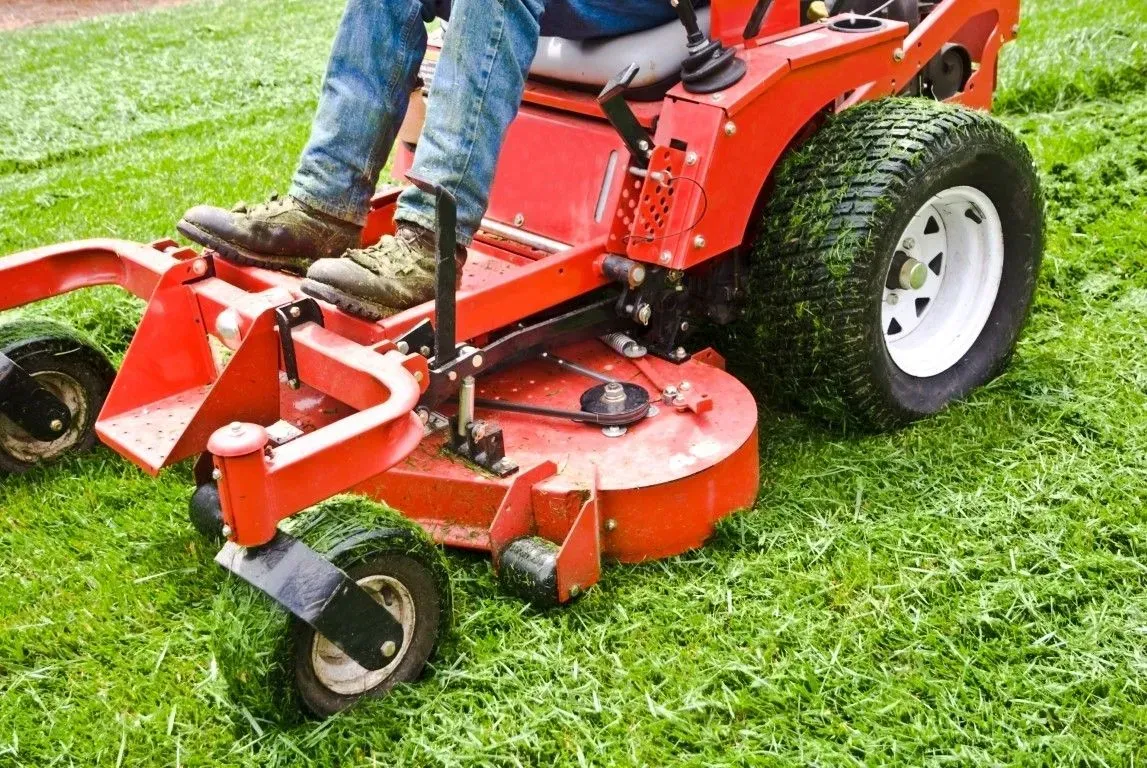
Professional lawn care starts with mowing height. University of Illinois Extension suggests keeping most lawns at 2½ to 3 inches and never taking off more than a third of the grass blade in one cut, so we set the deck to suit the grass rather than scalping it short.
That third-of-the-blade rule decides how often a lawn needs cutting. In spring a lawn will likely need mowing more than once a week, so the schedule follows the grass rather than the calendar. Clippings left on a lawn mowed this way break down and feed it, and Extension notes they don't cause thatch, so there's usually no need to bag them. Edging along the driveway, walks and curb and trimming around beds, trees and fences are part of the mowing service.
Fertilizing and Weed Control
For cool-season grass, the most useful feeding comes in late summer. Extension puts that window in August for northern Illinois, with a spring feeding in May and about a pound of nitrogen per 1,000 square feet at each feeding.
Weed control follows the soil temperature. Crabgrass sprouts once the soil stays above about 55 to 60°F for 7 to 10 days in a row, which in this part of the state means a preventer goes down from late April into early May. Broadleaf weeds such as dandelions and creeping Charlie are easier to kill in fall, and creeping Charlie usually needs one or two fall treatments to clear.
Illinois rule: Under the state's lawn care law, a paid applicator can only put phosphorus fertilizer on a lawn if a soil test from an approved lab, taken within the past 36 months, shows the lawn is short of it. Certain processed manure products and new lawns in their first two growing seasons are exempt from the test. No paid applicator may spread fertilizer on frozen or saturated ground.
Core Aeration and Overseeding
Fall is the best time to aerate a cool-season lawn, and the job goes best a few days after rain, while the ground is still slightly damp. Core aeration pulls small plugs of soil out of the lawn, which relieves compaction and helps water drain down to the roots.
This county gives its name to the McHenry soil series, established here in 1960: a well-drained soil formed in loess or other silty material over loamy glacial till on the area's moraines and till plains. Compacted lawns drain poorly whatever the soil, and aeration is how that's relieved. Overseeding straight after aeration puts seed into the open holes, where it touches bare soil. In this part of the state Extension's seeding window opens in early August and closes in early September, so thin patches get the rest of the growing season to fill in before the first fall freeze, which typically comes around October 11 (the median date) at the local weather station.
Grub Control
A common white grub in Illinois lawns is the Japanese beetle larva. Egg-laying peaks from late June to mid-July, and the damage, browning as the young grubs feed on the roots, typically shows from mid-August and can carry on into early October.
Where grubs are a known risk, such as a watered lawn among dry ones or a lawn that's had grub damage before, Extension suggests a preventive treatment before damage appears, with July as the example timing, and it doesn't recommend treating grubs in spring. It puts the threshold at about 12 grubs per square foot, the point where damage typically needs control; healthy lawns usually outgrow smaller numbers. Skunks and raccoons may dig up a lawn looking for grubs, though Extension notes they do it even when grub numbers are fairly low.
After a Treatment
Keep off until it dries. When a paid applicator treats a lawn in Illinois, the law requires a small white marker at the usual way onto the lawn reading "Lawn care application - stay off grass until dry." Keep kids and pets off until the grass has dried, and take the marker down the next day. A neighbor whose property borders the lawn can also ask the applicator to be told the day before a treatment.
Insured Crews That Clean Up
We're licensed and insured. Every visit finishes with clippings blown off the driveway, walks and patio, so nothing gets tracked into the house. Call for a free estimate and we'll look at the lawn, talk through what it needs and price it before any work starts.
Spring and Fall Cleanups
A spring cleanup rakes out winter debris and matted grass, edges the beds and gets the lawn ready for its first cut. In fall, leaf removal does more than tidy the yard. McHenry's weather station averages about 34.5 inches of snow a year, and Extension links snow mold to matted grass and leaves left lying under it, so its advice is to keep mowing until the grass stops growing and clear the leaves before winter.
Houses and duplexes can also use the city's curbside leaf collection. Flood Brothers Disposal, which handles refuse, recycling and yard waste collection for McHenry residents, picks up leaf piles every other week from the first full week of October to the first full week of December. Piles need to be within 4 feet of the curb or road edge by 6 a.m. on the Monday of your zone's week, with no branches or rocks mixed in and nothing on the pavement. Since July 1990, Illinois landfills haven't been allowed to accept yard waste for disposal, so leaves go out in paper yard-waste bags with the yard waste collection, never with the trash.
Typical Lawn Care Prices Around McHenry
Typical 2026 price ranges for regular lawn care and seasonal jobs, all on the same scale so you can compare them. Your own figure depends on lawn size, slope, access and how often the work is done, and the free estimate gives you the real number.
Regular lawn care
- Mowing with edging and blowing, per visit $30–$85
- Fertilizing, per application on a seasonal program $50–$140
- Weed control, per application $40–$125
Seasonal and one-off jobs
- Core aeration $75–$300
- Aeration with overseeding $150–$450+
- One-off fertilizer treatment $200–$400
- Fall leaf removal $150–$400+
- Spring cleanup $200–$500+
Bigger jobs cost more: heavy weeds, large or overgrown yards, heavy reseeding and heavily wooded lots can run past these ranges.
Typical prices around McHenry and the Chicago suburbs as published in 2026, for a lot of up to about a quarter acre, from published cost guides and local contractors' price pages. Not a quote: your free estimate gives the real figure for your lawn.
A Lawn Care Calendar for Northern Illinois
The median last spring freeze at the McHenry weather station is May 1 and the first fall freeze comes around October 11, which gives a growing season of about 162 days. The work fits around that:
- Early spring: cleanup and the first cut once the ground has dried and the grass is growing
- Late April to early May: crabgrass preventer
- May: spring feeding; growth is fast, so mowing can be needed more than once a week
- July: preventive grub treatment
- August: the main fertilizer feeding
- Early August to early September: overseeding, ideally straight after core aeration
- September to October: core aeration and fall weed control
- October to early December: leaf removal and the last mowings, until the grass stops growing
We follow the same calendar in Johnsburg, Wonder Lake, Crystal Lake and the other towns we cover. For tree and hedge work alongside the lawn, see tree and shrub trimming, and our landscaping in McHenry page covers everything else we do.
Lawn Care FAQs
Answers to the questions McHenry homeowners ask about their lawns.
How early in the year does lawn care begin?
As soon as the yard is dry enough to walk on without leaving prints and the grass has started growing, it's time for the spring cleanup and first cut. Crabgrass preventer goes down from late April into early May, before the soil warms enough for the seed to sprout.
How short should my grass be cut?
For most lawns, 2½ to 3 inches, which is University of Illinois Extension's advice. Extension also advises never taking off more than a third of the blade in one cut, so an overgrown lawn is brought down over more than one mowing.
How much does lawn mowing cost around McHenry?
For a lot of up to about a quarter acre on a regular schedule, recent published cost guides put a typical visit at about $30 to $85. Lot size, slope and how often it's cut change that, and the free estimate gives you the real price.
When is the best time to aerate and overseed?
At the end of summer. Aeration suits fall, and seed sown here from early August into early September has time to root before the cold, so pairing the two in late August or early September covers both.
Do you remove leaves in the fall?
Yes. Fall leaf removal is part of our seasonal cleanups. Extension advises clearing fallen leaves and mowing until the grass stops growing to help prevent snow mold, which shows up as yellowish to whitish-gray or pink-edged patches as the snow melts.
Which towns do you cover?
Crystal Lake, Woodstock, Wonder Lake, Johnsburg, Ringwood, Richmond, Spring Grove, Fox Lake, Island Lake, Prairie Grove and Lake in the Hills, as well as McHenry itself.
Are you licensed and insured?
Yes. Our crews are licensed and insured, and clean-up is part of every visit.
How do I book a free estimate?
Phone (815) 827-1515 or send the quote form on this page. We'll set a time to walk the lawn with you and price it, with no obligation.